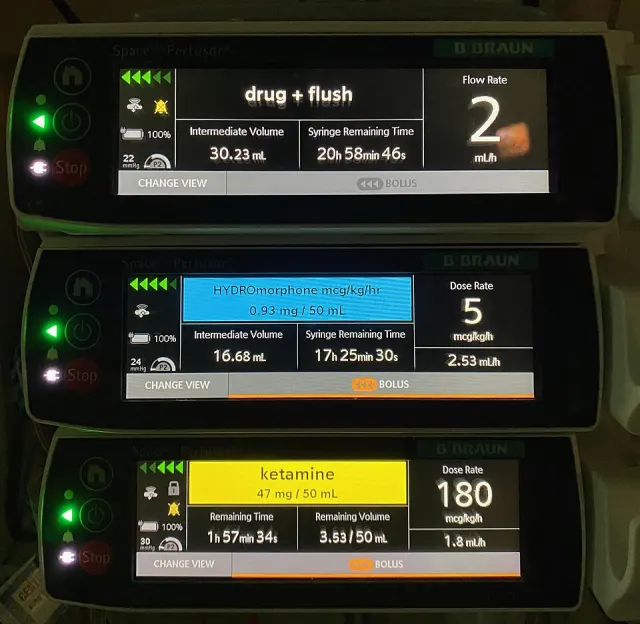
Syringe pumps: precise drug delivery at the critical care bed
Precision drug delivery at the ICU bedside.
The range above is an indicative planning figure taken from our own research, not a quotation and not an offer. buytogethr is pre-launch and has closed no pools.
What you are actually buying
A syringe pump delivers small, exact volumes over long periods, which is what vasoactive drugs, sedation, insulin and neonatal infusions require, and it is not a smaller volumetric pump. Accuracy depends on the pump recognising the syringe, so the makes and sizes it is calibrated for matter as much as the electronics. Buyers should look at the low end of the flow range, anti-bolus behaviour when an occlusion clears, near-end-of-infusion warning, and how many pumps a bedside dock will carry, because a single critical care bed commonly runs several at once. The recurring error is specifying syringe pumps and volumetric pumps as one line, and leaving syringe compatibility for the supplier to decide.
Why syringe pump suits collective purchasing
It pools well, and pools better alongside volumetric pumps than on its own, since the manufacturers, the authorised distributors and the bedside rack are usually shared. Quantity per bed is high, so a small group of institutions reaches a substantial count quickly, and there is little clinical disagreement to reconcile. Name the syringe makes and sizes in the common specification rather than leaving them open, because that single clause decides whether the pool's members can keep buying syringes competitively afterwards. Neonatal and anaesthesia use are the places to write a separate requirement rather than assume the general unit covers them.
Pin down before price
- Syringe makes and sizes the pump is calibrated to accept, matched to the syringes your group already buys
- Low end of the flow range and accuracy there, not only at mid-range rates
- Anti-bolus action on occlusion release, and adjustable occlusion pressure
- Bolus, dose rate calculation and near-end-of-infusion warning lead time
- Docking station capacity per bed, with mains and battery supplied through the dock
What drives ten-year cost
- Battery replacement and periodic flow verification across what is usually the largest pump fleet in the hospital
- Maintenance cover per pump, and whether the dock and rack are included or charged apart
- Being tied to particular syringe makes, which constrains syringe purchasing later
- Standby units, since a failed pump in a bedside column has to be swapped immediately