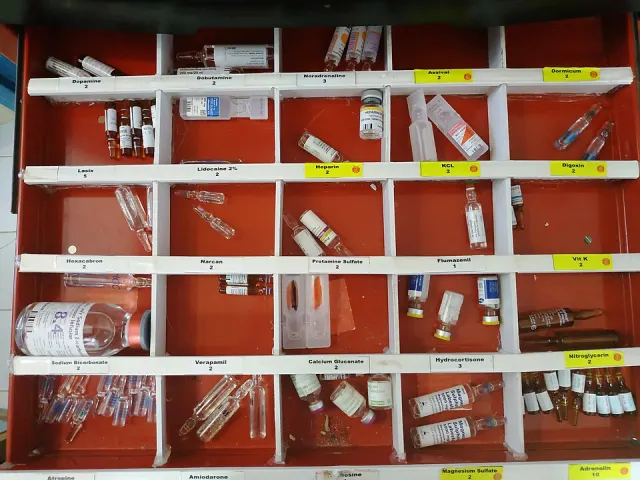
Emergency trolleys and one agreed crash cart layout across wards
Crash cart carrying emergency drugs and resuscitation equipment.
The range above is an indicative planning figure taken from our own research, not a quotation and not an offer. buytogethr is pre-launch and has closed no pools.
What you are actually buying
The purchase is the cart, not the crash contents. That means body material, drawer count and depths, tray inserts and dividers, a break-away seal or lock system, a CPR board, a defibrillator shelf with a stated load, oxygen cylinder holder, sharps mount, IV pole and braked castors. Drugs, airway equipment and IV stock are procured separately under their own controls. The mistake that costs most is buying a drawer layout that does not fit the institution's own crash contents list, so trays are improvised ward by ward; the related one is allowing different layouts in different departments, when the whole value of a resuscitation trolley is that staff can find things without looking.
Why emergency trolley suits collective purchasing
It pools cleanly on hardware and not at all on contents, and a pooled bid should keep the two firmly apart. The cart itself is a mechanical specification with a broad, largely domestic manufacturing base, so volume moves the price and the technical evaluation stays simple. The stronger prize is standardisation. If the institutions in a pool agree one drawer layout and one seal system before bidding, every trolley in every department across the group reads the same, contents lists become interchangeable and restocking simplifies. That agreement is worth more over a decade than the unit price it is negotiated alongside.
Pin down before price
- Drawer count, individual drawer depths, and whether trays and dividers are supplied
- Break-away seal or lock system, with numbered seals quoted as an ongoing consumable line
- Mounted accessories and their ratings: CPR board, defibrillator shelf load, cylinder holder, sharps bracket, IV pole
- Body material and finish, tested against your disinfection routine rather than assumed
- Overall width and castor size against corridor, lift and bay access; the agreed layout written into the specification
What drives ten-year cost
- Numbered seals, replaced at every check for the life of the trolley
- Castors and drawer runners, the parts that fail on a cart in constant movement
- Finish degradation under repeated disinfection, which decides whether the cart lasts five years or fifteen
- The checking and restocking regime, where the real recurring cost of a crash cart sits